Aviator Game Mechanics: How the Crash Game Works
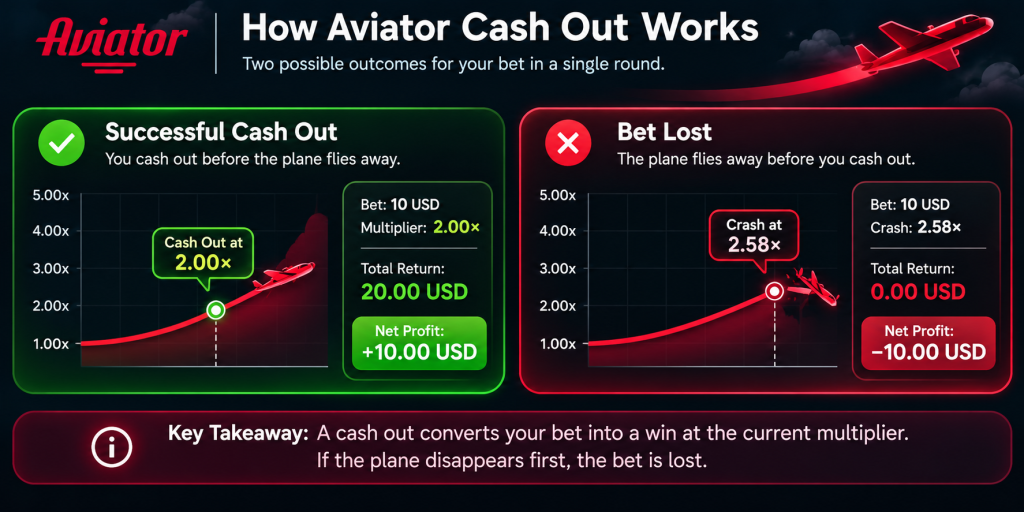
The central rule is straightforward: a successful cash-out returns the stake multiplied by the accepted cash-out coefficient. If the flight ends before a bet is cashed out, that stake is lost.
Behind this simple interface are several important systems: round generation, multiplier progression, bet settlement, automatic controls, two betting panels, and Provably Fair verification.
This guide explains how these mechanisms work, what the published rules establish, and what cannot be predicted from the information displayed during a flight.
Aviator Game Mechanics at a Glance
Unlike a traditional slot machine, Aviator does not use spinning reels or paylines. Its main visual element is a flight animation accompanied by an increasing multiplier.
| Mechanic | How It Works |
|---|---|
| Game developer | SPRIBE |
| Game format | Multiplayer crash game |
| Starting multiplier | 1.00x |
| Bet placement | Before takeoff |
| Round endpoint | Generated before the round begins |
| Successful cash-out | Stake multiplied by accepted coefficient |
| Uncashed bet | Lost when the flight ends |
| Automatic controls | Auto Bet and Auto Cash Out |
| Simultaneous bets | Up to two betting panels |
| Published RTP | 97% |
| Result verification | Provably Fair system |
The aircraft and rising curve provide a visual representation of the round. The important financial events are the acceptance of a bet, the acceptance of a cash-out, and the end of the round.
The Five Stages of an Aviator Round
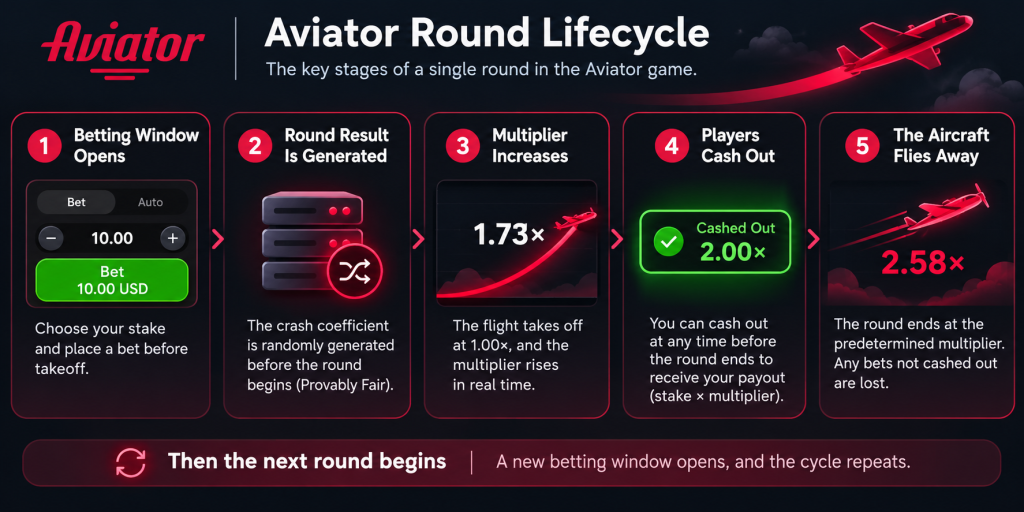
Each round follows a repeating sequence. Understanding these stages helps explain why timing and bet settlement matter.
1. The betting window opens
Before takeoff, players can choose a stake and submit a bet. A betting panel displays the amount and the available controls.
The stake must be accepted during the betting period to participate in that round.
2. The round result is generated
According to Aviator’s published rules, the coefficient at which the aircraft will fly away is generated before the start of the round by its Provably Fair randomisation system.
Players do not see this future endpoint during the active flight.
The rising animation should therefore not be understood as the aircraft making a new random decision every second.
3. The multiplier begins increasing
When the round starts, the displayed multiplier begins at 1.00x and increases as the aircraft flies.
As long as the round remains active, the potential total return on an open bet increases with the multiplier.
However, a higher displayed multiplier is not a realised payout until the bet has been successfully cashed out.
4. Players can cash out
During the flight, a player may request a cash-out for an active bet.
If the request is accepted before the flight ends, the bet is settled at the accepted multiplier.
Different players can cash out at different points during the same round.
5. The aircraft flies away
At the predetermined endpoint, the flight ends.
Any bet that has not been successfully cashed out is lost, subject to the applicable game rules for exceptional events.
The result then appears in the game’s history, and the next betting cycle begins.
Important: The flight endpoint is shared by players participating in that round. One player’s cash-out does not end the round for everyone else.
How Does the Aviator Crash Multiplier Work?
The multiplier is the central element of Aviator’s gameplay. It determines the potential total payout of a bet that is successfully cashed out.
At the beginning of the flight, the multiplier starts at 1.00x. It then increases until the round reaches its predetermined endpoint.
Why does the multiplier increase?
The rising multiplier represents the growing potential return available to players who still have active bets.
For example, a successful cash-out at 2.00x produces twice the original stake as a total payout.
At 5.00x, the total payout is five times the stake.
But reaching a higher multiplier requires the flight to continue longer. The game can end before a selected target is reached.
Is the crash point random?
The published rules describe the round coefficient as being generated by a Provably Fair randomisation system before the round begins.
The exact outcome is not disclosed to players while the round is active.
Observing the aircraft’s movement, the curve, or previous multipliers does not provide a verified way to determine the next endpoint.
Can the aircraft crash immediately?
A round may end at a very low multiplier, leaving little or no opportunity to complete a profitable cash-out.
There is no guaranteed minimum profitable multiplier that every round must reach.
Does a high multiplier mean the next round will be low?
No. A high result does not, by itself, establish that the next result must be low.
Similarly, a sequence of low multipliers does not mean a high multiplier is due.
Past results are records of completed rounds, not reliable predictions of future endpoints.
How Does Cash Out Work in Aviator?
Cash Out is the mechanism used to settle an active bet before the flight ends.
When a player requests a cash-out, the game processes the request according to its rules. If accepted in time, the return is calculated using the accepted coefficient.
Manual Cash Out
With manual cash-out, the player decides when to request settlement.
For example, a player may attempt to cash out at 1.80x. If the request is successfully accepted at that coefficient, the total payout equals the stake multiplied by 1.80.
If the aircraft disappears before settlement, the bet is lost.
Why does cash-out timing matter?
The multiplier can change while the flight remains active. A value briefly displayed on screen should not be confused with a confirmed settlement.
The relevant value is the coefficient actually accepted and recorded by the game.
Players can review settled bets in the My Bets section.
Does pressing Cash Out guarantee a win?
No. A cash-out request must be accepted before the round ends.
If the request is too late, it may not result in a successful payout.
For practical instructions, read How to Play Aviator.
How Are Aviator Payouts Calculated?
The basic payout formula is:
Total Return = Stake × Accepted Cash-Out Multiplier
Net profit is calculated separately:
Net Profit = Total Return − Stake
Example: A 10-unit stake
| Accepted Multiplier | Total Return | Net Profit |
|---|---|---|
| 1.20x | 12 | 2 |
| 1.50x | 15 | 5 |
| 2.00x | 20 | 10 |
| 3.00x | 30 | 20 |
| 5.00x | 50 | 40 |
| No successful cash-out | 0 | −10 |
These figures are mathematical examples, not actual round results or guaranteed outcomes.
Does the payout include the original stake?
Yes. The total return includes the original stake.
For example, a 10-unit bet successfully cashed out at 2.00x returns 20 units in total. The net profit is 10 units.
What happens if the flight ends before the target?
If the player is waiting for 3.00x but the aircraft flies away before that target is reached, the open stake is lost.
A larger potential payout therefore comes with the risk that the required multiplier will never be reached.
How Do Auto Bet and Auto Cash Out Work?
Aviator includes automatic controls designed to reduce the need for repeated manual actions.
Two functions should be distinguished: Auto Bet and Auto Cash Out.
Auto Bet
Auto Bet automatically places bets according to the selected settings.
According to the published rules, enabling Auto Bet does not automatically cash out those bets.
Without Auto Cash Out, a player still needs to handle cash-out during each active round.
Auto Cash Out
Auto Cash Out allows a player to specify a target multiplier before the flight.
If the multiplier reaches the configured target while the bet remains active, the game attempts automatic settlement according to its rules.
For example, an Auto Cash Out target of 2.00x means the bet is intended to settle automatically when the game reaches the specified coefficient.
If the flight ends before the target, the stake is lost.
Auto Bet vs Auto Cash Out
| Feature | Auto Bet | Auto Cash Out |
|---|---|---|
| Main purpose | Automatically places bets | Automatically settles at a target |
| Requires manual cash-out? | Yes, unless Auto Cash Out is also enabled | No manual request for the configured target |
| Predicts the crash point? | No | No |
| Eliminates losing rounds? | No | No |
Automatic controls execute predefined instructions. They do not change the underlying round result or guarantee a profit.
How Do Two Bets Work in the Same Aviator Round?
Aviator supports a second betting panel, allowing up to two bets to be placed during the same round.
Each panel has its own stake and cash-out controls.
Both bets participate in the same flight and therefore share the same round endpoint.
Example: Two bets with different targets
Consider two hypothetical bets of 5 units each:
| Panel | Stake | Target | Potential Total Return |
|---|---|---|---|
| Bet 1 | 5 | 1.50x | 7.50 |
| Bet 2 | 5 | 3.00x | 15.00 |
If the flight ends at 2.00x, the first bet could have been successfully settled at 1.50x, while the second bet would lose because 3.00x was not reached.
The combined result would be:
- Total stakes: 10 units.
- Return from Bet 1: 7.50 units.
- Return from Bet 2: 0 units.
- Combined net result: −2.50 units.
This example illustrates why one successful cash-out does not necessarily mean the overall round was profitable.
Do two betting panels reduce the game’s house edge?
No. Two betting panels do not create two independent flights or remove the game’s mathematical advantage.
They allow different settlement instructions within the same round, but the total amount at risk is the sum of both stakes.
How Does Aviator’s Provably Fair System Work?
Provably Fair is a system designed to allow players to verify the integrity of completed game outcomes using cryptographic information.
SPRIBE’s published Aviator rules state that each round coefficient is generated through a Provably Fair algorithm.
The rules also describe tools for checking completed rounds through the game interface.
What is generated before the round?
According to the published rules, the coefficient at which the aircraft will fly away is generated before the start of each round.
This means the future endpoint is established before players watch the multiplier rise.
However, knowing that the endpoint has been generated does not mean players can discover it in advance.
What does cryptographic verification mean?
Cryptographic verification uses mathematical operations to check information associated with a completed round.
In a typical Provably Fair design, cryptographic commitments help demonstrate that underlying values were not secretly changed after they were committed.
The exact verification procedure must follow the documentation and data supplied by the particular game.
How can players verify a completed round?
The published Aviator rules describe access to fairness verification through the game’s history and related result panels.
- Open the game’s history or the relevant completed-bet panel.
- Select the fairness verification control associated with a completed result.
- Review the information supplied by the game.
- Follow the verification procedure provided by the game interface.
Verification is retrospective: it concerns a round that has already been completed.
Can Provably Fair predict the next crash?
No. A verification system is not a prediction system.
Its purpose is to help verify the integrity of completed results, not reveal future outcomes before they occur.
Claims that a predictor app, signal service, or modified game client can reliably disclose the next Aviator multiplier should be treated with scepticism.
Is the exact crash formula publicly documented?
The published rules establish that Aviator uses a Provably Fair randomisation system, but a complete independently verified reconstruction of every implementation detail should not be assumed from that description alone.
Third-party formulas presented online may model crash-game behaviour without reproducing SPRIBE’s exact production implementation.
How Do RTP and House Edge Affect Aviator Mechanics?
SPRIBE’s official Aviator product page lists a theoretical Return to Player (RTP) of 97%.
RTP is a long-run mathematical measure of the proportion of total wagered amounts expected to be returned through payouts under the applicable game model.
It is not a guarantee for any particular session, bet, or player.
What does 97% RTP mean?
At a theoretical RTP of 97%, the corresponding house edge is:
House Edge = 100% − 97% = 3%
For illustration, across 1,000 units of total wagering volume, a 3% house edge corresponds to a theoretical expected loss of 30 units.
This is an expectation over extensive play, not a forecast of an individual player’s result.
Does a lower cash-out target remove the house edge?
No. Choosing a lower multiplier may change how often a bet is successfully cashed out and how large its payout is.
It does not, by itself, eliminate the game’s published mathematical advantage.
Does waiting for a higher multiplier improve expected returns?
A higher multiplier increases the payout if the bet is successfully settled, but it also requires the flight to continue to a more demanding target.
It should not be assumed that choosing larger multipliers creates a reliable positive expectation.
For more detail, read our Aviator RTP and House Edge Guide.
How Do Round History and Live Statistics Work?
Aviator provides several information panels that help players review game activity.
Round history
The history displays multipliers from completed rounds.
It can be used to review previous outcomes and access available fairness information.
However, history does not reveal the next round’s predetermined endpoint.
Live Bets
The Live Bets panel displays information about bets being placed during the current round.
This is a social and informational feature of the multiplayer game.
Visible betting activity should not be treated as evidence that the next multiplier will be high or low.
My Bets
The My Bets panel provides information about the player’s own bets and cash-out results.
It is useful for checking whether a bet was settled and which coefficient was recorded.
Top statistics
The Top panel provides access to selected game statistics, including notable payouts and coefficients.
These statistics describe past events and do not establish a reliable forecasting method.
What Happens During Connection Problems or Game Errors?
Network interruptions can affect what a player sees on screen and whether a manual action can be submitted.
One published version of Aviator’s rules states that an active bet is automatically cashed out at the current coefficient if the internet connection is interrupted.
However, players should consult the rules applicable to their specific game installation rather than assume every operator handles interruptions identically.
What should you do if the game disconnects?
- Reconnect to the game or operator account.
- Review the account balance and My Bets history.
- Check whether the interrupted bet was settled.
- Record the round details if the result appears incorrect.
- Contact the operator’s support team when a settlement requires investigation.
A browser animation freezing does not necessarily establish that the game server has stopped processing the round.
The operator’s recorded settlement and applicable game rules are more important than the last multiplier visible on a frozen screen.
Frequently Asked Questions About Aviator Game Mechanics
How does the Aviator game actually work?
Aviator is a crash game in which players place bets before takeoff and attempt to cash out while a multiplier rises. A successful cash-out pays the stake multiplied by the accepted coefficient. An uncashed bet is lost when the flight ends.
Is the Aviator crash point predetermined?
Yes. SPRIBE’s published rules state that the round coefficient is generated before the start of each round through its Provably Fair randomisation system.
Does the plane animation determine the result?
The animation visually represents the round and its rising multiplier. The published rules describe the endpoint as being generated before the round begins.
Can Aviator crash at a low multiplier?
Yes. The flight can end at a low multiplier, potentially before a profitable cash-out is completed.
What happens if I do not cash out?
If the flight ends while a bet remains open, that stake is lost under the normal game rules.
How is the Aviator payout calculated?
The total payout equals the stake multiplied by the accepted cash-out coefficient. For example, a 10-unit stake settled at 2.00x returns 20 units in total.
What is the difference between Auto Bet and Auto Cash Out?
Auto Bet places bets automatically according to the configured settings. Auto Cash Out attempts to settle an active bet when the specified multiplier is reached.
Can I make two bets in one Aviator round?
Yes. Aviator supports a second betting panel. Both bets participate in the same flight but can have separate stakes and cash-out instructions.
Can two Aviator bets both lose?
Yes. Because both bets share the same flight endpoint, both can lose if the flight ends before either is successfully cashed out.
What does Provably Fair mean in Aviator?
Provably Fair refers to a cryptographic verification system that allows players to check information associated with completed game outcomes. It does not reveal future crash points.
What is the RTP of Aviator?
SPRIBE publishes a theoretical RTP of 97%, corresponding to a 3% house edge. This does not guarantee any particular result.
Can previous multipliers predict the next crash?
No. Previous multipliers are historical results and do not provide a verified method for forecasting the next round.
Can I practise Aviator mechanics for free?
Yes, where a genuine demo is available. You can explore the game’s controls using virtual credits without placing real-money bets. Visit our Aviator Demo page.
Final Thoughts: Understanding Aviator’s Core Mechanics
Aviator combines a predetermined round endpoint with a rising multiplier and player-controlled cash-out decisions.
Its most important mechanics are straightforward: bets must be placed before takeoff, successful cash-outs are settled at an accepted coefficient, and open bets are lost when the flight ends.
Auto Bet, Auto Cash Out, and dual betting panels change how bets are submitted and managed. They do not remove the game’s mathematical house edge or make future crash points predictable.
The Provably Fair system provides a way to verify completed results, while the published 97% RTP describes a theoretical long-run return rather than a guaranteed session outcome.
To explore these mechanics without real-money stakes, visit our Aviator Demo. For beginner instructions, read How to Play Aviator.